By
Pierre Deguée
On PLONGER by Cie Menteuses
This article is part of the “inter-magazine Circus Festival” projects that is a collaboration between the UP – Circus & Performing Arts Festival, the Université Libre de Bruxelles and five international circus magazines, Around About Circus, Malabart, Juggling Magazine, StageLync, and Dynamo Magazines, all part of the INCAm network. Students at Université Libre de Bruxelles share their thoughts on current stage and circus performances. Their diverse backgrounds—ranging from literature, journalism, acting, to cultural studies—bring unique perspectives, whether familiar with the art form or newcomers. They are united by a curiosity for performing arts, which led them to the MA Arts du spectacle program, offering exposure to various art forms, including the circus. As part of the Circus|Studies, an interdisciplinary and international research project led by Dr. Franziska Trapp, theatre students explore circus dramaturgy, collaborate with emerging artists, and engage in performance analysis and critique. Their experiences culminate in MA theses or articles like the following.
I haven’t often gone to see circus in my life. At least, I haven’t sought it out. For me, these were shows that punctuated my vacations during street festivals or served as interludes at small music festivals. That’s that. My centers of gravity, meaning the activities that attract me, revolve around philosophy and theater. That’s where I come from. It was only this year that I began to become aware of the issues at play in circus work. So, I speak as an outsider, and I have the good fortune, reserved for those discovering a new discipline, of seeing everything as new, strange, and open to questioning.
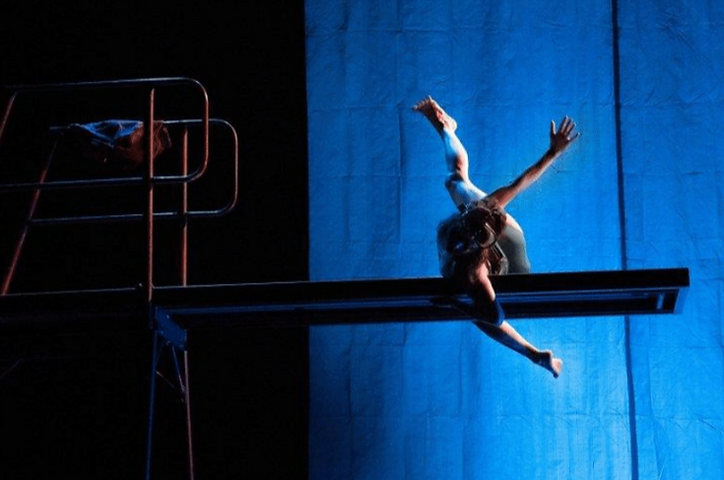
In this regard, one show caught my attention: Plonger. It was created by the Belgian artist Sarah Devaux from the company Menteuses. The story follows an insomniac woman, suspended on a diving board, wondering if she will take the leap. Assisted by the pool’s caretaker, who mirrors her conscience, she asks herself if she will jump. She jumps. From there, we accompany her through different layers of water, waters that could be both marine and the depths of the human psyche. From a scenography rooted in the everyday life of a public swimming pool, the show navigates back and forth between the world of geological depths and that of consciousness.
What touched me about this show is that, while it was programmed in a Belgian circus festival and performed by a circus artist trained in a circus school, this circus show wasn’t exactly that. At least, it defied the usual promises and expectations of a public who had come to see circus: there was text, there were acting scenes between characters, and around that, the use of apparatus, the controlled use of risk, and spectacular movements revolved. Big words, but in this case: the circus underpinned the theater. At least, that was the feeling and feedback I sensed in the room once the show was over.
We would be wrong—but we come from a French and Greco-Latin cultural background, and we find ourselves in French-speaking Belgium, so forgive us our trespasses—to so quickly categorize and say, ‘Ah, this was circus, this was theater. Period.’ Plonger achieves, in my view, a tour de force: it hybridizes the genres and allows them to coexist. There was circus and theater on stage at the same time, without one destroying or dethroning the other. It was circus because the risk was real: the circus artist could have fallen several meters when, suspended at the end of the diving board, she performed movements while only her fingers held her in place for those long moments.
It was theater because the risk was also that the character might fall 10,000 meters into the abyss of her own consciousness. Which risk prevails? At that moment, neither. Both are visible at the same time.
The theatrical element did not overshadow the spectacular performance. We weren’t so absorbed by the story and its outcome that we forgot about the circus artists performing physically. The characters served as figures of reflection. They reminded us of our own capacity to take risks and dare to jump. These characters did not fit into a narrative that would make us forget what we were truly seeing: two artists struggling with gravity around a diving board.
The circus did not overshadow the theatrical meaning precisely because that meaning was too well-established to give way to the spectacular gestures. There was a dramaturgical coherence that prevented the show from becoming just a series of acts. The circus gained from being theatrical. But perhaps we are already reminding it of that too often…
Maybe I’m writing for the wrong magazine. I could have written this review for a theater magazine and said how Plonger is a theater show, but one that uses the body for what it is, and that these spectacular, strange movements, or moments of risk, are enough to make me feel things and question my relationship to the world. I could have said that theater also has much to gain from being inspired by this circus presence. Or even more, I could have turned it into an injunction, a manifesto: Let theater be circus! But we’ll save that for another time.
Or simply that in Plonger, there was body and spirit. And that is already enough for us.
Article de Pierre Deguée publié dans le magazine DYNAMO

